Today we’re introducing the PacKit Package Manifest, an open format used to describe Windows application packages for deployment platforms such as Microsoft Intune and Configuration Manager, for now.
When packaging applications, important information is often spread across multiple systems:
- Installer files
- Detection rules
- Installation and uninstall commands
- Deployment requirements
- Documentation (Word, Excel, SharePoint, etc…)
As packages evolve, keeping all of this information synchronized becomes increasingly difficult.
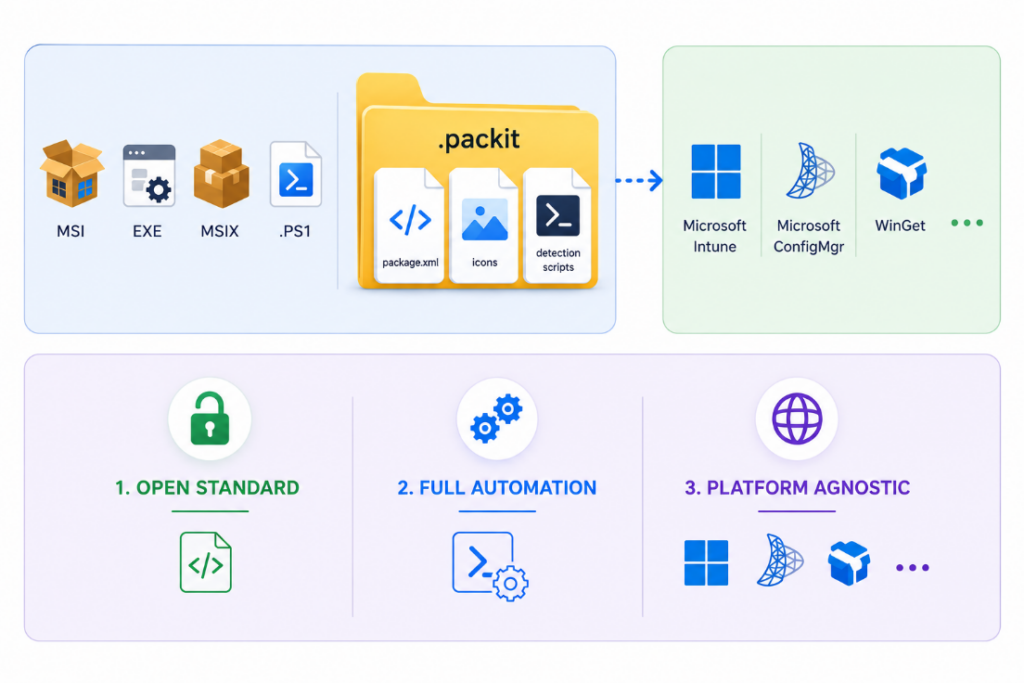
The PacKit Package Manifest, aka fragment, addresses this problem by storing package metadata directly alongside the package source, in a folder called “.packit”. You can create this folder using the free edition of PacKit or the free PowerShell module.
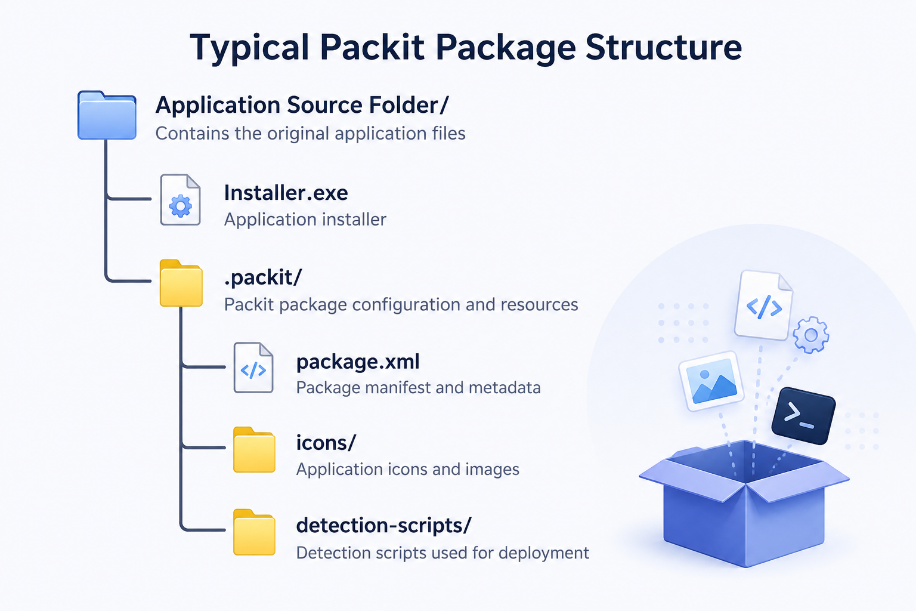
The manifest acts as a single source of truth for the package and contains information such as:
- Application identity and publisher
- Installer configuration
- Silent installation parameters
- Uninstall commands
- Detection methods
- Platform requirements
- Additional deployment metadata
PowerShell PacKit Module
Although the manifest is currently used by PacKit, it is intentionally stored as an open format within the package structure, 100% under your control via de free PowerShell Module – https://github.com/Caphyon/open-package-manifest

This means the same package definition can be consumed by:
- PowerShell automation
- CI/CD pipelines
- Intune deployment workflows
- Configuration Manager integrations
- WinGet publishing tools
- Internal application repositories
The goal is to make package information portable, version-controlled, and accessible from any environment.
In-house Developers
Do you have in-house developers who package the apps without talking to admins? Just ask them to generate a .”packit” package manifest next to their setup and your Intune admins will have all they need to automate their deployment.
They can use the PowerShell PacKit module to build it no matter what tool they used to build their MSI or EXE setup.
Watch the webinar recording to learn more about the Open Package Manifest (OPM)
Looking forward
This is only the first step.
By keeping package definitions in a structured, portable format, organizations gain greater control over their application lifecycle and open the door to richer automation scenarios in the future.
We look forward to seeing what the community builds around the .packit package manifest.